
Say the words defensible space to somebody who just bought six acres of timber and watch what happens. They picture a ring of stumps. The house sitting out in the open in the middle of its own bare circle, and the reason they wanted the trees in the first place hauled off on a truck.
That is not what the term means. The clearest description of it I have come across lately came from a fire district describing its own building.
Northern Lakes Fire Protection District went before the Kootenai County Hearing Examiner in August, applying for a satellite station of its own. In that hearing, case CUP26-0007, the district said it would build to “Firewise landscaping standards (5-ft and 30-ft defensible zones)” and would maintain “100-ft of natural vegetation” around the station.
Read the second half of that again, because it is the half everybody drops. A hundred feet of natural vegetation, maintained. Not removed. The trees are still standing at a hundred feet, and at fifty, and at thirty-five.
Those are two different jobs. The inner one is housekeeping close to the walls: nothing stacked against the siding, the needles off the roof and out of the gutters, the ground cover low and green rather than dry and woody, and no ladder of small trees leading up into the crowns of the big ones. Idaho Firewise puts numbers on the two things people get wrong most often out here, and both are the same number. Firewood at least thirty feet from the building, and the propane tank at least thirty feet away as well. A stack of rounds against the south wall is the most common way a careful person undoes the rest of it. The outer one is forestry. You take out the crowded stems so the crowns are not touching, leave the healthy ones room, and clean up what is lying on the ground. When it is done well it looks like woods somebody works in, which is what it is, rather than woods somebody mowed.
Idaho Firewise, the non-profit that coordinates wildfire education in this state, divides the same ground into three and the names tell you the whole story. Clean and green nearest the house. Pruned and groomed beyond it. Native vegetation furthest out, which is the one worth reading twice, because what it asks for there is spacing rather than removal: ten by twelve or twelve by twelve feet between trees and woody shrubs. Its trifold puts distances on them too, and they are the ones you will see everywhere once you start looking: zone one is the house and the first five feet, zone two runs five to thirty, zone three thirty to a hundred and beyond. Those are NFPA’s figures, which Idaho Firewise reproduces and Northern Lakes committed to by name. So the numbers in this piece are not three sources agreeing by coincidence. They are one framework, quoted by a fire district, a state non-profit and a county code in turn.
One thing in that trifold is going to read strangely on ground like this, and it is better said than skirted. Its list of what to avoid near the house begins with plants that carry volatile oils and resins, and it names pine, spruce and juniper. In zone two it says, plainly, avoid conifers. We are selling six-acre lots in ponderosa and mixed conifer. The advice is not wrong and it is not aimed at the timber on your back forty: it is about what you plant against the siding, in the first thirty feet, where a resinous shrub is a wick. The forest stays. The foundation planting is where you get to choose.
The county puts a number on it. Describing what a wildfire mitigation plan has to cover, the code asks for plans to eliminate dangerous fuel conditions in and around building sites, and says canopy cover in those areas “should be less than fifty percent”. Less than half is a thinning, not a clearing. It wants lower branches pruned, the ground kept reasonably free of debris, and ladder fuels and dead and dying trees taken out, and then it says something I did not expect to find in a code: “Snags that do not present a fire hazard should, however, be left standing to provide habitat for birds and wildlife”. A dead tree that is not a danger is worth more standing than felled, and somebody wrote that down.
Now the part that matters more than either zone, and the reason I wanted to write this down rather than put it on a brochure. There are two separate moments here and they get mixed up constantly.
The first one is ours, and it happens before anybody owns a lot. Kootenai County’s land use code says a subdivision has to meet the requirements of the fire protection district with jurisdiction, and it names defensible space in that list, alongside roads, driveways, fire flows, hydrants and water storage. Then it asks for more on ground like this. A major subdivision in a timbered area has to have a wildfire mitigation plan written by a professional forester, approved by the county and by the fire district, and that plan “must be implemented as part of the required improvements for the subdivision”. At the end of it the forester signs again, certifying that what the plan said would happen did.
The second moment is yours, and it comes later. The fire district that serves this ground is Timberlake Fire Protection District, and when Timberlake was asked about a subdivision case in 2025, case CUP25-0004, the minutes record its division chief and fire marshal, Kody Wright, responding in a letter dated April 25 of that year that conditions and requirements would be applied at the time of building permit application. That is the district looking at your house, on your lot, when you are ready to build it.
So it is not that nothing is required. It is that the first requirement lands on us and the second on you, and neither of them lands on the day you buy.
If you would rather see the shape than read about it, the homesite sketchpad on any lot page draws both zones now. Put a building down and the trees inside thirty feet come out from under it; the band from thirty to a hundred thins, with the rest of the parcel left alone.
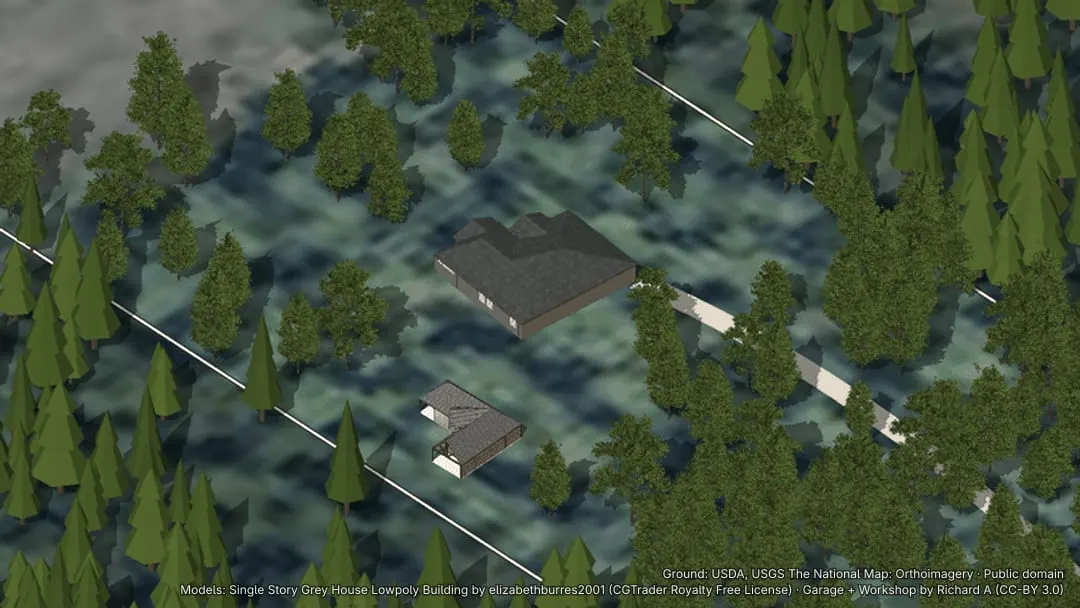
That, drawn rather than photographed: a house and a shop on parcel 21, the ground cleared close in and the timber thinned beyond it. There is no house at Clagstone to photograph, so this is our own renderer working from the approved plat. The ground under it is USGS orthoimagery.
What to actually plant
The distances get all the attention and the plant list is the part you will use. Idaho Firewise picks for four properties: high moisture content, soap or latex or pectin in the sap, a low compact growth form, and drought tolerance so it stays green without you watering it all summer. Everything below is hardy to zone 5 or colder, which is what you need up here.
Groundcovers and low perennials for the first few feet: hardy ice plant (Delosperma hybrids), lipstick strawberry (Fragaria hybrid), Firewitch dianthus (Dianthus gratianopolitanus), Angelina stonecrop (Sedum rupestre), hens and chicks (Sempervivum spp.), evening primrose (Oenothera macrocarpa) and giant soapwort (Saponaria x lempergii).
Natives and drought perennials further out: sulphur buckwheat (Eriogonum umbellatum), Venus penstemon (Penstemon venustus), firecracker penstemon (Penstemon eatonii), blue flax (Linum lewisii) and yellow wild indigo (Baptisia spp.), which fixes its own nitrogen.
Subshrubs and shrubs where you want some height: Powis Castle silver sage (Artemisia hybrid), Pawnee Buttes sand cherry (Prunus besseyi), Autumn Amber sumac (Rhus trilobata), mock orange (Philadelphus hybrids), John Cabot rose (Rosa hybrid) and Spitfire quince (Chaenomeles speciosa).
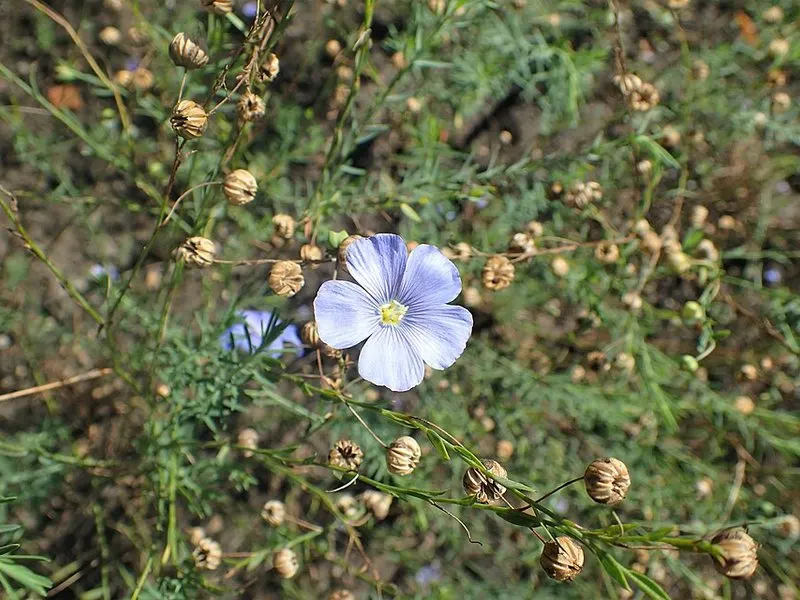
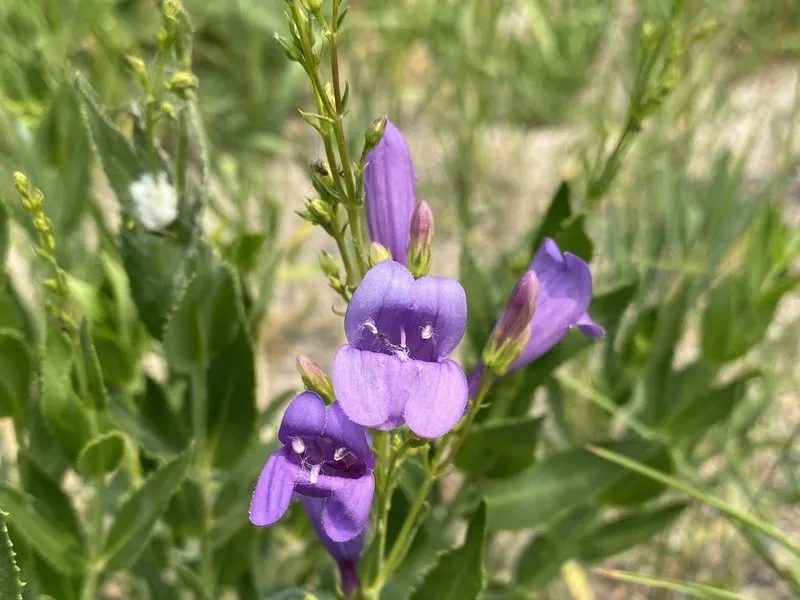
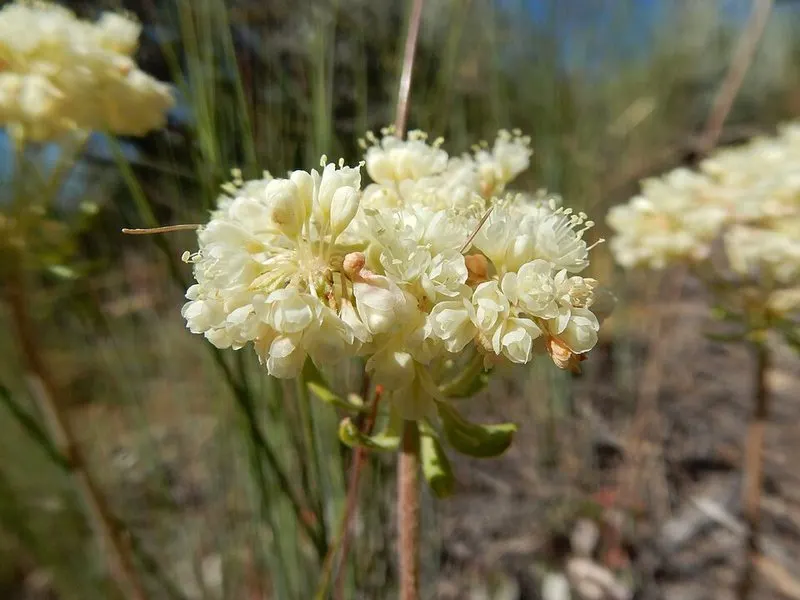
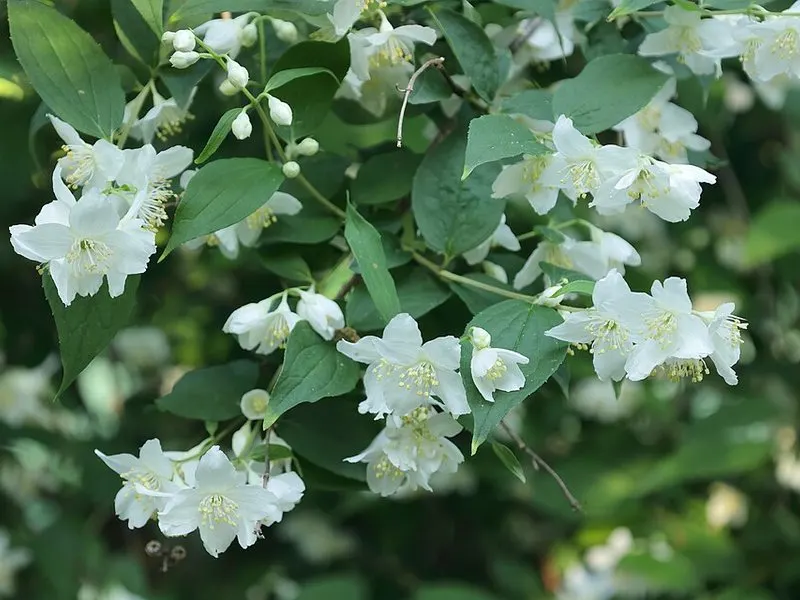
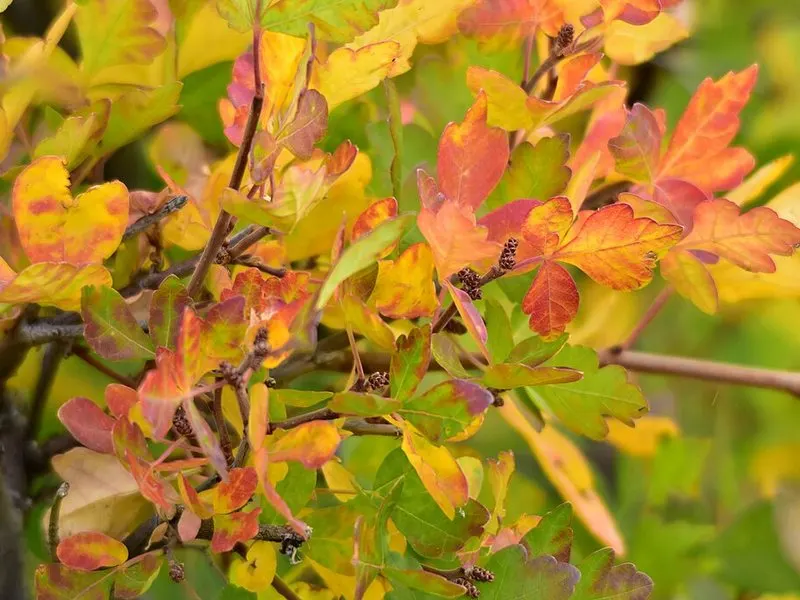
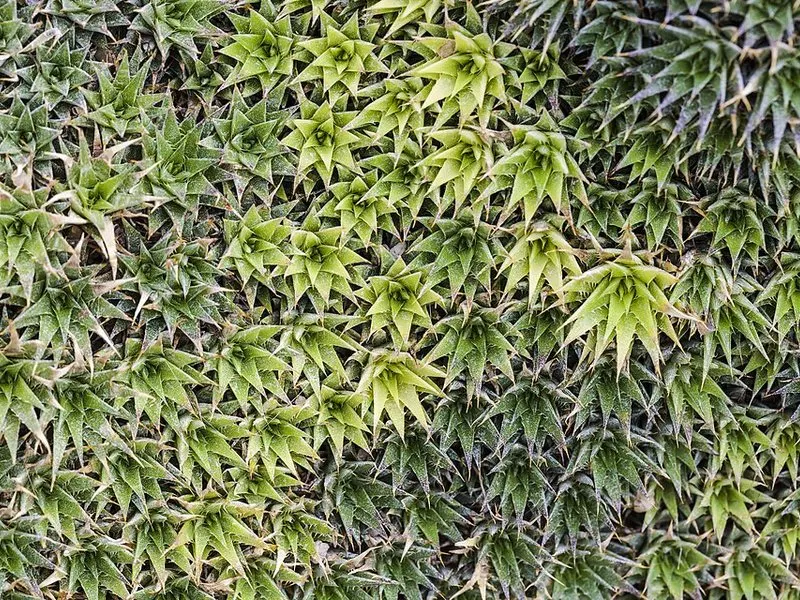
Six of the eighteen, so you know what you are looking for at the nursery. None of these was photographed at Clagstone, and none is the named cultivar the trifold lists: these are the species. The identifications are the photographers' own, and every photographer is credited on credits.
Mock orange is worth a second look. It is a relative of syringa, Philadelphus lewisii, which is Idaho’s state flower, so the thing that belongs here anyway is also on the list.
The species and their selection are Idaho Firewise’s, from the trifold linked below. The demonstration garden those pictures come from is in Boise, which is a different climate from this one, so treat the list as a starting point and ask a nursery in Sandpoint or Coeur d’Alene what actually takes up here.
Which is the thing worth noticing when you look at it on a six-acre homesite. The circle is smaller than the picture in your head.
Updated September 22, 2026.